Why trim is its own job
Walls get looked at. Trim gets touched. Baseboards take vacuum hits and boot scuffs, door edges take hands every day, and stair balusters take backpacks and dogs. That is why trim, doors and stairs need a different paint, a different sheen and a different level of prep from the walls next to them. It is also where a cheap paint job shows first: brush marks in raking light, chipped door edges, and a baseboard that turns yellow two winters in.
This page covers that woodwork on its own: refreshing trim in a room you are not otherwise touching, converting dated stained trim to paint, painting a full set of interior doors, or taking a worn staircase back to something sharp. For walls and whole rooms, see our interior painting page, and for dented walls around that trim, drywall repair and painting; for kitchen cabinets, which share a lot of the same products, see cabinet painting.
Who it is right for, and when paint is the wrong answer
Painting trim and doors makes sense when the wood is sound and the look is the problem: golden 1990s oak casing in a Westborough or Shrewsbury colonial, builder-white trim gone dingy in a Hudson split-level, or scuffed doors in a Leominster ranch.
It is the wrong answer when:
- The stained woodwork is original and good. Chestnut or quarter-sawn oak casing in an older Worcester or Clinton home is hard to get back once it is painted. Sometimes the right call is to clean and refinish it instead.
- There is rot. Soft window sills and door jambs need carpentry first. Paint over rot is money wasted.
- Doors bind or will not latch. Paint adds thickness. A door that rubs now will stick after two coats unless it is planed and adjusted first.
What it costs in Central MA
These are typical ranges for 2026, not quotes. Your written estimate itemises the scope, the named products and anything excluded.
| Typical scope | Typical Central MA range |
|---|---|
| Baseboard, casings and one door in one room | $350–$800 |
| Interior door, both sides plus casing | $150–$350 per door |
| Front entry door, both sides, premium enamel | $300–$700 |
| Stained trim converted to painted, per room | $600–$1,400 |
| One staircase: risers, stringers, balusters and newel | $900–$2,500 |
| Whole-house trim and doors, typical three-bedroom colonial | $4,000–$9,000 |
What moves the number: how many coats the color change needs, whether the old paint is oil, how much caulking and filling there is, and how many panels and profiles each door has. A six-panel door takes far longer than a flat slab.
How the job runs, step by step
A typical scope looks like this:
- Protect. Floors covered with rosin paper, walls masked along the trim line, hardware removed and bagged by room.
- Clean. Door edges and stair rails carry skin oil. Everything is washed with a degreaser and rinsed, because paint does not bond to grime.
- Test and sand. We test whether the existing paint is oil or latex, then scuff-sand to dull the gloss. Stained, varnished trim gets sanded and primed with a bonding or stain-blocking primer so tannins in oak do not bleed through.
- Fill and caulk. Nail holes filled, open miters and gaps between trim and wall caulked. This step is what makes new paint look like new trim.
- Prime. Spot-prime repairs and bare wood; full prime when changing from stain or oil.
- Two finish coats. Brushed on casings and baseboards; doors either brushed or sprayed off their hinges. Light sanding between coats on doors people will look at up close.
- Cure and rehang. Doors stay propped until the enamel will not stick to the stops, then go back with hardware.
Timeline: one room is usually a day. A whole-house trim and door package in a typical colonial runs one to two weeks, mostly waiting on dry times between coats.
Choosing the enamel
Wall paint is too soft for trim. Trim needs an enamel that levels out brush marks and cures hard enough to resist marks and sticking. The products we use most:
- Benjamin Moore ADVANCE. A waterborne alkyd made for trim, doors and cabinets. It flows out like an oil paint and cleans up with water. The trade-off is patience: Benjamin Moore lists a 16-hour recoat time.
- Sherwin-Williams Emerald Urethane Trim Enamel. A water-based, urethane-modified alkyd for trim, doors and cabinets, rated for interior and exterior use and made to resist yellowing compared with traditional oil paint. A good pick for white trim in bright rooms.
- C2 Cabinet & Trim. C2’s formula built for trim, doors and cabinets, useful when you have chosen your wall colors from C2’s palette and want the woodwork to match.
- Fine Paints of Europe Hollandlac. An oil enamel from Holland. Hollandlac Brilliant is an ultra high-gloss finish that brushes out to a mirror-like surface, which is why people use it on front doors and period entries. It is slow: the manufacturer lists 16 hours to recoat and about 21 days to reach full hardness.
- Farrow & Ball Flat Eggshell. A 20% sheen, water-based finish for wood and metal. It gives trim a softer, lower-sheen look that suits older houses and Farrow & Ball’s colors. It replaced the Estate Eggshell finish many people still ask for by name.
Sheen matters as much as brand. Semi-gloss is the practical standard for baseboards and doors. Satin looks softer and hides flaws in old woodwork. High gloss is for a statement front door, and it shows every dent under it.
Stairs: the hardest-working paint in the house
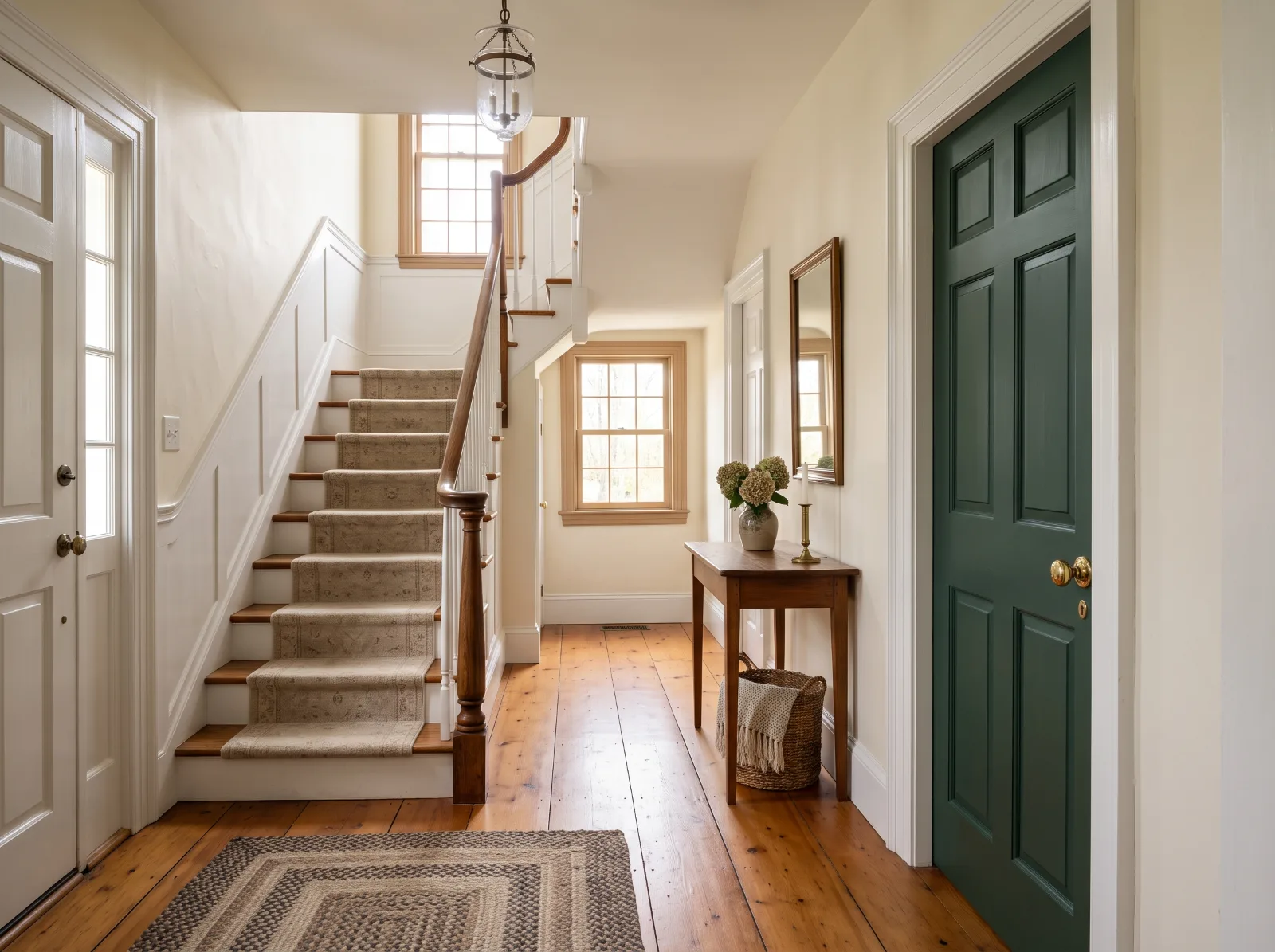
Stairs combine every problem at once: foot traffic, hand oils on the rail, and dozens of balusters with four faces each. Most of the cost is the balusters. We usually paint risers, stringers, skirt boards and balusters in enamel and leave treads and handrail stained with a clear coat, because painted treads wear through at the nosing first. If you want painted treads, they need a floor-rated coating and a runner is worth considering.
Carpeted stairs in a 1970s Marlborough or Framingham house often hide pine treads that were never meant to be seen. Before you pay to paint them, see our hardwood flooring page; new oak treads are a separate carpentry job.
New England issues
- Humid summers, dry winters. Wood doors swell in August and shrink under January heat. We seal the top and bottom edges of doors when they are off the hinges; bare edges soak up moisture and cause warping.
- Blocking. In humid weather, fresh enamel on a door can stick to the stop and tear. Products rated for block resistance and proper cure time prevent this.
- Lead in older homes. Much of the trim in pre-1978 houses carries lead paint under newer coats. Sanding, scraping or stripping it falls under EPA RRP and Massachusetts lead-safe rules. Ask any contractor for their Massachusetts lead-safe renovation credentials in writing before work that disturbs paint in a pre-1978 home. Our guide to painting older homes covers the options for heavily layered trim.
What to ask any painter
- Which product will you use on trim and doors, by name, and in what sheen?
- How will you test and prime over existing oil paint?
- Are doors coming off the hinges, and will the edges be sealed?
- How long before doors can be closed and hardware reinstalled?
- For a pre-1978 home: can you show your Massachusetts lead-safe credentials in writing?
If you want a firm number, book a free in-home consultation. We look at the woodwork, test the existing paint, show you sheen and color samples, and send a written estimate with the products named.
Common questions
Can you paint over oil-based trim with water-based enamel?
Yes, but not straight on. Glossy oil paint has to be cleaned, scuff-sanded dull and primed with a bonding primer first, or the new coat can peel off in strips. A quick test: rub a spot with denatured alcohol. If the paint softens, it is latex; if it does not, treat it as oil.
How long before doors can be closed after painting?
Waterborne alkyd enamels are dry to the touch in hours but take days to harden. Benjamin Moore lists a 16-hour recoat time for ADVANCE, and oil enamels like Hollandlac take weeks to reach full hardness. We leave doors propped and hardware off until the finish will not stick to the stop.
Should stair treads be painted?
Risers, stringers and balusters paint well. Treads take heavy foot traffic, so painted treads need a floor-rated coating and will show wear first. Many homeowners keep treads stained and clear-coated and paint everything else, which is a classic New England look.
Is it worth painting doors instead of replacing them?
Usually, if the doors are solid, square and swing properly. Paint is a fraction of the cost of new doors. If a door is warped, split or hollow-core and damaged, replacing it is the better spend, and our carpentry side can hang new ones.
Does my pre-1978 house change anything?
Yes. Sanding or scraping old trim in a pre-1978 home can disturb lead paint, and that work falls under EPA RRP and Massachusetts lead-safe rules. Ask any contractor for their Massachusetts lead-safe renovation credentials in writing before work that disturbs paint begins.