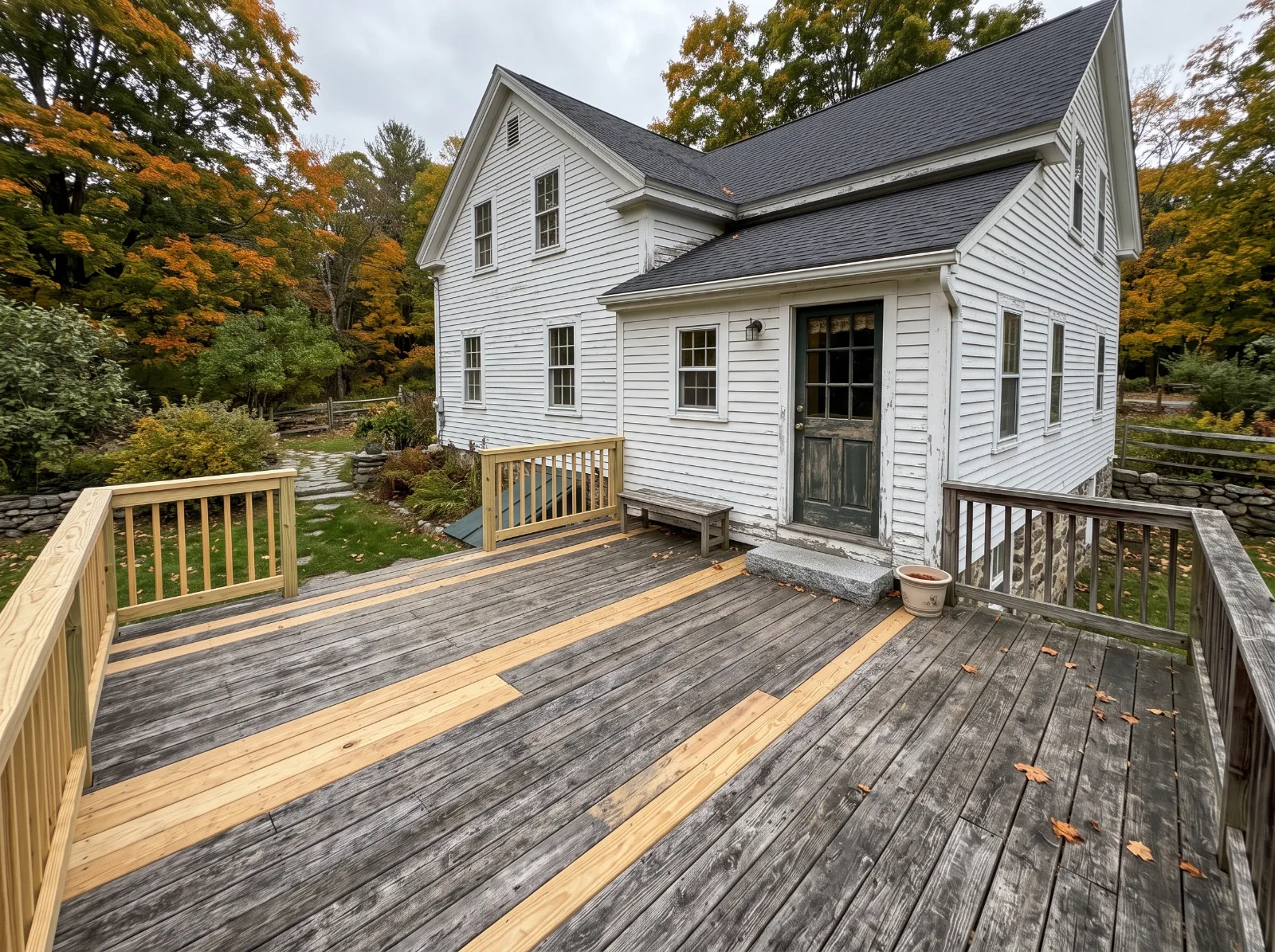
When a deck needs attention
Most decks don’t fail all at once. They give warnings for years, and the warnings are easy to miss because the boards on top can look fine while the frame underneath rots. Here’s what to look for, roughly in order of seriousness:
- The ledger. Go under the deck and look where it meets the house. Is it bolted through, or only nailed? Is there metal or membrane flashing tucked behind the siding and over the ledger? Dark streaks and soft wood here are the most serious sign on any deck.
- Soft wood. Push an awl or screwdriver into the tops of joists, the ends of beams and the base of posts. If it sinks in easily, that wood is rotting.
- Wobbly rail posts. Lean hard on each post. Movement usually means a notched post, a twisting rim or rot at the bolts.
- Rusted hardware. Flaking joist hangers and corroded bolts, especially on older decks built with plain steel.
- Posts and footings. Posts set in the soil or on precast blocks, footings that have heaved, or posts leaning out of plumb.
- Stairs. Stringers pulling away at the top, cracked treads, or a bottom step sitting on dirt.
- Missing lateral hardware. Newer code details tie the deck back to the house framing to resist sideways movement. Older decks rarely have this.
If you find item one or two, don’t wait for spring cleanup.
Resurface or rebuild?
This is the real decision on most older decks, and it hinges on the frame, not the boards.
Resurface (new boards and railing on the existing frame) makes sense when the joists are solid top to bottom, the ledger is bolted and flashed or can be corrected, the footings are below frost depth, and the joist spacing matches what the new boards need. That’s often true of decks built in the last 15 years.
Rebuild makes sense when the ledger was never flashed and the rim behind it is soft, the footings are shallow blocks, many joists are soft on top, or the frame spacing would need so many new joists that you’re paying for a new frame anyway. Putting composite or PVC boards on a failing frame means paying twice.
A middle path we often recommend: keep the sound footings and beams, replace the ledger and joists, then deck and rail new. A typical scope looks like that on a 20-year-old deck whose footings pass but whose joist tops are gone.
What deck repairs cost in Central MA
National guides put ledger replacement and joist repairs at a few hundred to a few thousand dollars, but they rarely include opening the wall, shoring the deck, or Massachusetts labor. These are typical ranges, not quotes:
| Typical scope | Typical installed range |
|---|---|
| Replace a small area of boards or stair treads | $500–$2,000 |
| Rebuild a rail section with reinforced posts | $1,000–$3,000 |
| Sister or replace a run of soft joists | $1,500–$5,000 |
| Resurface 16x20 on a sound frame, pressure-treated | $4,500–$6,500 |
| Resurface 16x20 on a sound frame, composite | $12,000–$17,000 |
| Tear-off and full rebuild with new ledger, flashing and footings | $9,000–$22,000 |
Repairs are the hardest deck work to price sight unseen, because rot rarely stops where it looks like it stops. Our written estimate itemises what we’ll replace, what we’ll check once it’s open, how any hidden damage would be priced, and what’s excluded.
What the job involves
- Inspection. We go under the deck, probe the frame, check the ledger, measure joist spacing and footing depth where visible.
- Permit. Structural repairs are filed with the town.
- Shoring and demo. Temporary posts carry the deck while the ledger or beams come out. Old treated wood is bagged and disposed of properly.
- House-side repair. Siding off at the ledger, rim and sheathing checked and repaired, flashing installed.
- Structure, then surface. New ledger, joists or posts, joist tape, then boards and railing.
- Inspection and cleanup.
A ledger repair is usually two to four days. A resurface runs three to seven days. A full rebuild is similar to a new deck.
New England issues for older decks
Frost-heaved footings. Decks built on precast blocks or shallow holes move every winter. Proper footings go below frost depth, commonly 48 inches in Central Massachusetts; confirm with your town.
Older houses. Triple-deckers and older colonials in Worcester, and the mill-era houses in Clinton, often have back decks and stairs added over decades by different hands. We expect to find mixed lumber, undersized joists and surprises at the house wall. The 1960s ranches around Hudson and Marlborough often have a ledger nailed straight through the siding.
Lead paint. Opening siding on a pre-1978 house disturbs old paint. EPA lead-safe rules apply to that work. Ask any contractor for their lead-safe certification in writing before it starts.
Hidden water damage. If rot has run into the sill or wall framing, it becomes a water damage restoration job, and sometimes a building restoration job, before it’s a deck job.
What to ask any contractor about deck repair
- Did you go under the deck and probe the frame, or just look at the boards?
- How will you attach and flash the new ledger?
- How deep are my footings, and will you reuse them?
- How will hidden damage be priced if you find it?
- Will the repair be permitted and inspected?
If the answer is a rebuild, compare boards on our pressure-treated deck and PVC deck pages, and railings on deck railings and stairs.
Next step
We’ll come out for a free consultation: get under the deck, check the ledger, frame and footings, and follow up with a written estimate that itemises the repair, what we’ll verify once it’s open, and what’s excluded.
Common questions
How do I know if my deck is safe?
Look for a ledger that's nailed rather than bolted or has no flashing, soft or spongy wood when you push a screwdriver in, rail posts that move when you lean on them, rusted hangers, posts sitting on blocks or buried in soil, and stairs pulling away. Any of those is worth a professional look before the next party.
Can you just put new boards on my old frame?
If the frame, ledger and footings are sound and the joist spacing suits the new boards, yes, and it saves real money. If the joists are soft at the top, the ledger has no flashing or the footings are shallow, new boards only hide the problem, and we'll tell you so.
Do deck repairs need a permit in Massachusetts?
Replacing a few boards usually doesn't. Structural work such as a new ledger, joists, beams, posts, footings, stairs or guards usually does. Towns differ, so we check with your building department and file when it's required.
My deck is from the 1990s. Is the old treated wood a problem?
Residential treated lumber made before the end of 2003 was usually treated with CCA, which contains arsenic. It's not a danger sitting there, but it shouldn't be burned or sanded into dust, and it gets bagged and disposed of properly. We plan for that on tear-offs.
What if the rot goes into the house wall?
Water that got behind an unflashed ledger can rot the rim joist, sill or sheathing. We open the wall enough to find sound wood, repair it, and flash it correctly before a new ledger goes on. Larger hidden damage becomes a water damage repair.