Kitchen remodeling in Leicester, MA
Kitchen remodeling in Leicester runs across three kinds of house: antiques near the village centres, mid-century capes and ranches, and newer houses out on the bigger rural parcels. The mid-century houses supply most of the work, and their kitchens are small rooms shut off from everywhere else. Almost every job here begins with the wall somebody wants gone.
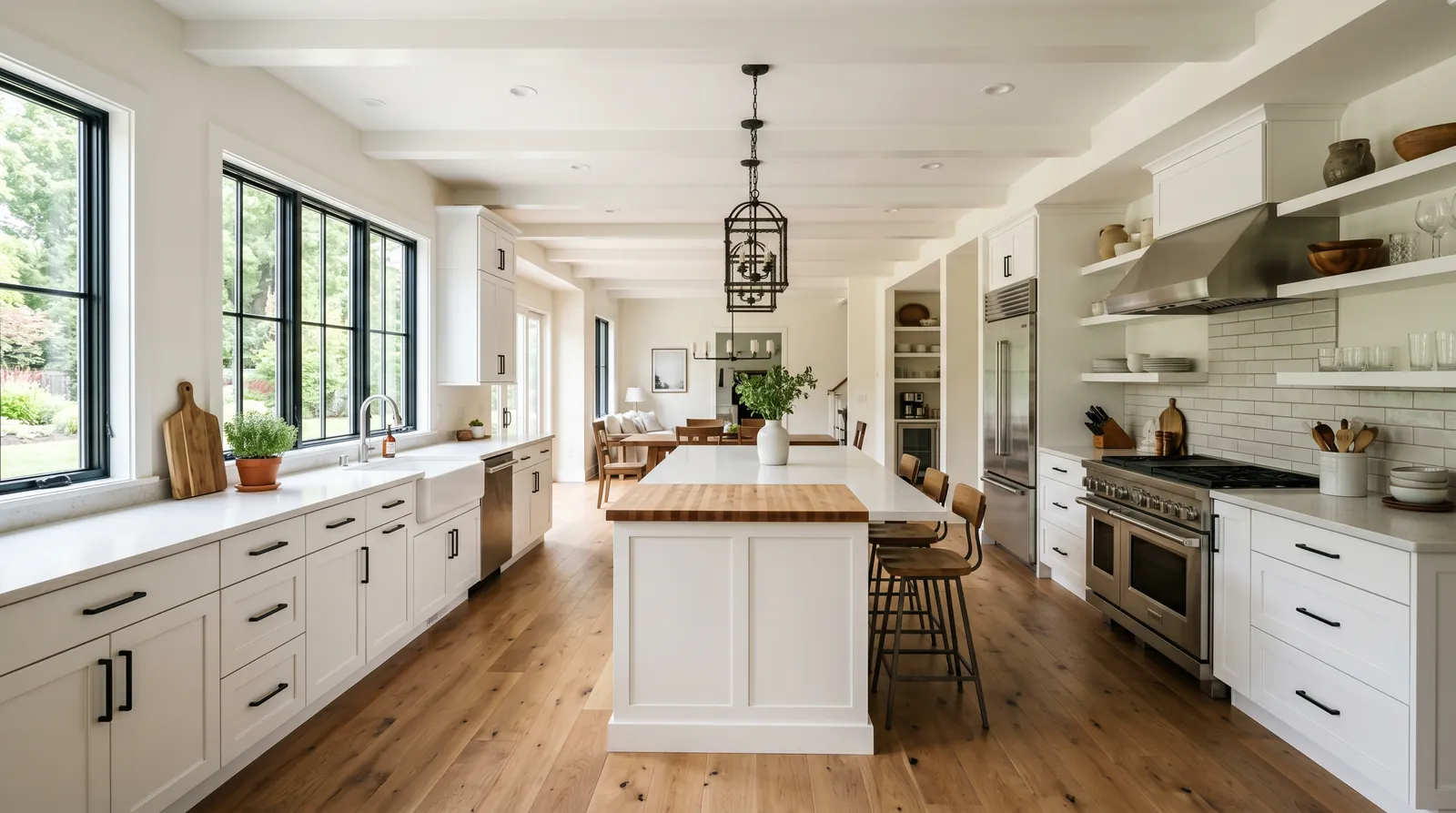
The houses this is written for
The stock here is antique houses around the centres, mid-century ranches and capes, and newer homes on larger rural lots.
Kitchens that were built to be closed
A mid-century kitchen in this town is a compact box with a doorway to the hall and an opening to the dining area, and that is the whole of it. It was designed as a work room, not a place to sit. Modern households want the opposite, so the ask is nearly always to connect it to the living space and put a run of counter or an island where a partition stands now.
The antique houses around the centres keep their kitchens at the back, frequently in an ell or a later addition. Those rooms are lower, lighter framed and often sitting on a shallower foundation than the main block. The newer houses on the rural lots have the space already and the work there tends to be about storage, appliances and daylight rather than knocking anything down.
What is actually inside the wall you want gone
In this stock that partition carries load more often than not. It is holding the ceiling joists, and in a cape it may be holding the floor of the rooms above as well. Opening it means a header sized for the span, posts at each end, and bearing carried down to the foundation. That last part is where the cost sits, and it is why we look in the basement before quoting an opening.
The waste stack is the second occupant. Kitchen and bathroom drainage in mid-century houses was grouped to keep pipe runs short, so the line frequently sits in or beside the wall in question. We would rather design the opening around it than relocate it, but where it has to move, it moves properly and gets re-vented, not notched around. Cutting a structural member to make room for pipe is never the answer.
Old branch wiring is the third. Circuits in these houses were run before anybody needed a dedicated line for a dishwasher, and they wander through partitions in ways no drawing records. When a wall opens we trace what dies with it and rebuild those circuits deliberately instead of splicing extensions in behind new board. Junction boxes stay accessible, and nothing live gets buried in a finished wall.
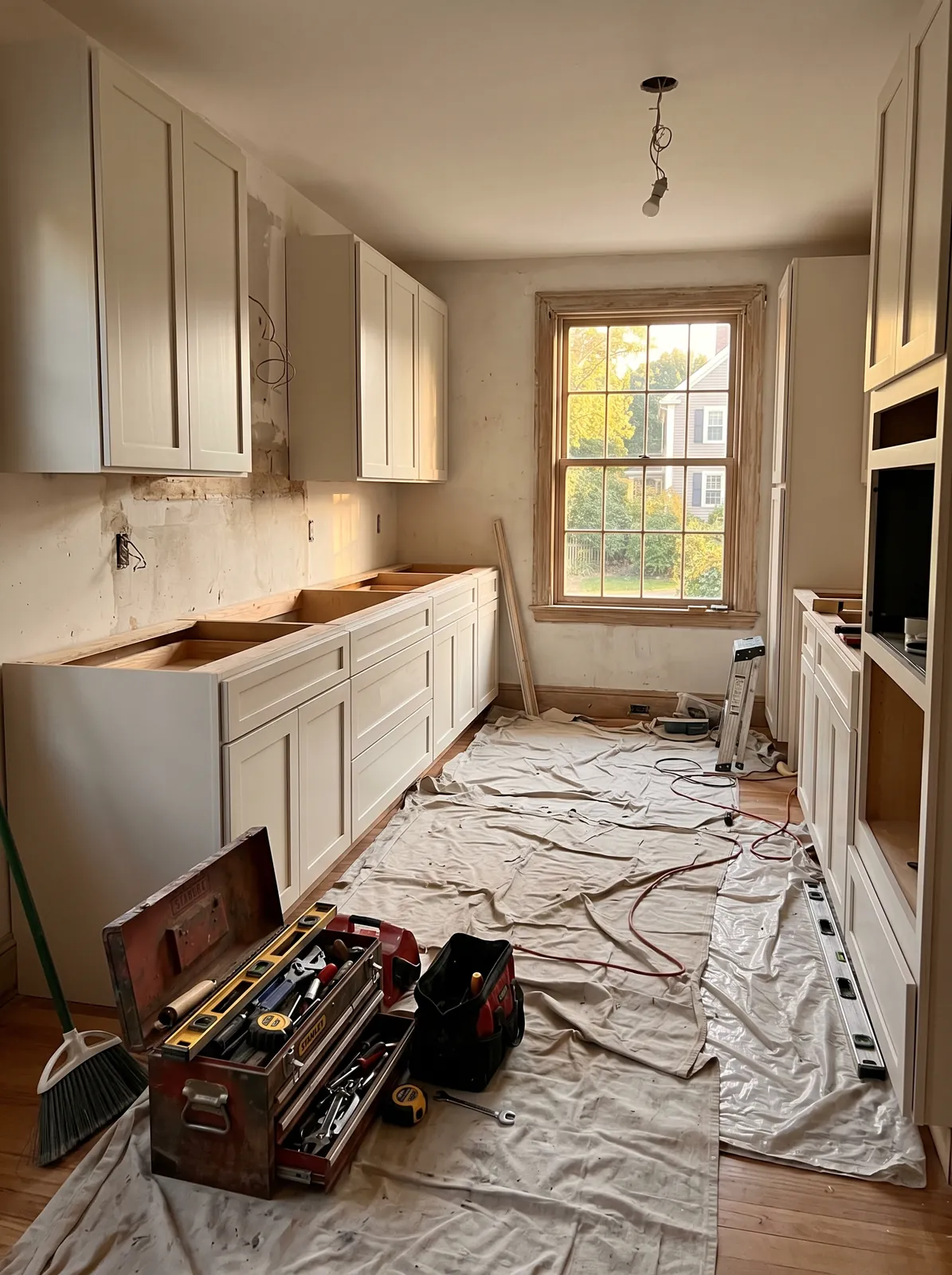
Services change from one village to the next
Leicester does not follow a single rule on services. Whether an address has town sewer or a private system genuinely differs from one street to the next, so it gets confirmed for that address rather than assumed from the neighbourhood. The same goes for water. That check happens at the first visit because it changes several decisions at once. It also tells us who else needs to be involved and when.
If the house is on a private system, we generally leave the food disposal out. A Title 5 system is not built to digest ground food waste, and adding solids shortens the interval between pumpings. A deep sink and a good strainer basket do the job. On town sewer the disposal is simply a preference, and the only thing worth checking is the condition of the branch it empties into.
Well water changes the appliance conversation. Hardness and iron scale up dishwashers, mark stainless and stain a new sink, and pressure at the far end of a long run is worth measuring rather than guessing. If there is no treatment in place, that discussion belongs before the appliances are ordered, not after the first cycle leaves spots on the glassware.
The panel, and venting the range outside
Mid-century panels were sized for a kitchen with a range, a fridge and a light. A current one wants dedicated circuits for the range, dishwasher, microwave and fridge, plus counter circuits and lighting. We count the spare spaces early so a service change is written into the scope instead of appearing halfway through. Doing that work while the electrician is already on site keeps the cost down.
Range hoods get vented outside through an exterior wall. In a ranch that is generally a short run, which is one of the easier things about this stock, and it usually makes sense to put the range on an outside wall for that reason. The duct route is worked out before the layout is fixed, because it can decide where the range ends up.
Grade, exposure and how the job runs
Access here is generally comfortable, but the driveways are longer and there is real grade on the higher ground. That matters for a container and for delivery trucks, particularly in winter. We work out where the container sits, how a truck turns and whether a long drive needs sanding before a start date goes in the diary. Frozen ground and a steep drive are a bad combination for a loaded truck.
The work itself runs in a fixed order: design and written scope, demolition, structural work, rough plumbing and electrical, inspection before anything is covered, then insulation, board, cabinets, counters, tile, trim and paint, with appliances last. While a wall on the weather side is open, we look at insulation and air sealing, because up on the exposed ground that wall works harder than the same wall down in a valley.
Questions we get asked about Leicester
Do you work in Leicester?
Yes. Leicester is 19 miles from our base in Lancaster, well inside the area we cover day to day.
Is the wall between our kitchen and living room load bearing?
In this stock it usually is, or it is carrying part of the load. We open a small section and look at which way the joists run and what sits above before anything is promised. If it is bearing, the opening needs a header and posts, with the load carried down to the foundation, and that gets priced up front.
How do we find out whether we are on sewer or septic?
We confirm it for your address rather than going by the street, because in Leicester it changes from one part of town to the next. The answer affects whether a disposal makes sense and how any new fixture is handled. It takes one check at the first visit and it prevents a decision being made on a wrong assumption.
Can we have a disposal on a private system?
We normally advise against it. A Title 5 system is not designed to take ground food solids, and feeding it more means pumping more often. A deep sink with a proper strainer handles daily use without loading the tank. If you want one regardless, that is a conversation to have with whoever services your system first.
Our well water leaves spots on everything. Will a new kitchen fix it?
Not by itself. New fixtures and a new dishwasher will pick up the same hardness or iron the old ones did. We measure pressure at the kitchen and look at what treatment exists. If there is none, sorting that out before the appliances arrive protects the money you are about to spend on them.
Does being up on the hill change anything about the work?
It shows up in the envelope rather than the cabinets. Exterior walls on the exposed ground take more weather, so while one is open for a window or a hood duct we look hard at insulation and air sealing. It also affects site logistics, since a long sloped driveway in February needs planning for deliveries.
What paperwork do we get before work starts?
A written estimate that itemises scope, materials and exclusions, then a written contract before any work begins. Ask us for our registration and insurance details in writing and we will provide them directly — we do not publish those numbers online.
Do you pull permits?
Yes. We pull the building permit on any work that requires one; the plumber and electrician file their own trade permits, and we coordinate them. Permitting in Leicester goes through the town's building department and it is written into the scope we quote rather than added later.
Also in Leicester
Nearby towns
Tell us about your Leicester project.
We will come and look at it, and you will get a written scope and price.
(508) 656-7436 1171 Main St, Lancaster, MA 01523 Office visits by appointmentGot it.
Your details are with us. We'll be in touch to arrange a look at the project. If it's urgent, call (508) 656-7436.